
X

[wpdreams_ajaxsearchlite]

Frequently Asked Questions

Water, Safety & System Basics

Quench Buggy only uses municipally approved potable water sources. This can include fire hydrants, garden hose connections, or other approved access points depending on the location. This ensures the water meets public health standards and is safe for consumption at events or workplaces.

The systems can connect to any potable, city approved water source such as a hose bib, water fountain, or approved hydrant. This flexibility allows the units to be used across a wide range of environments.

Yes, all Quench Buggy units include filtration systems that improve water quality by reducing sediment and chlorine taste. Some configurations may also include additional filtration methods such as UV.

Yes, the systems are designed for public and commercial use and rely on approved water sources combined with filtration to ensure safe drinking water.

Yes, all models can provide chilled drinking water when connected to a power source. This is especially important in hot environments or high activity settings.

Service, Staffing & Operations

A trained Quench Buggy staff member manages the unit from delivery through to the end of the event. This includes setup, monitoring, and ensuring consistent performance.

Yes, all rentals include trained staff who are responsible for operating and maintaining the unit during use.

No, the system is fully managed. Your team does not need to handle any operational responsibilities.

On site staff are present to address any issues immediately and ensure that the system continues to operate smoothly.

Cleaning, Maintenance & Hygiene

Yes, all units are cleaned inside and out before each event and are also maintained during the event to ensure cleanliness and hygiene.

Staff monitor the system throughout operation, ensuring that the unit remains clean and functioning properly for all users.

Pricing & Availability

Pricing is determined based on several factors including location, number of attendees, duration, and event details. A custom quote is provided after discussing your specific requirements.

Each event or use case is different, so pricing is tailored to ensure the right setup and level of service is provided.

Quench Buggy rentals are available across Canada and the United States, and services can also be provided internationally depending on the project.

Branding & Customization

Yes, customers can apply their own graphics. Templates are available to make the process easier, and many clients choose to brand the units for their events.

Yes, units can be customized with branding for sponsors, events, or organizations, providing both functionality and visibility.

Yes, branded hydration stations are often used to give sponsors visibility while enhancing the attendee experience.

Water Supply & Storage

Yes, customers can apply their own graphics. Templates are available to simplify the process, and many clients choose to brand the units for their events.

Yes, all units are designed to connect directly to municipal water sources for continuous supply.

Yes, alternative water supply methods such as tanks or trucks can be used depending on the setup.

Technical Specifications

The Quench Buggy trailer weighs approximately 3500 lbs empty and up to 7000 lbs when full. The Quench Cart is around 700 lbs and the Quench Solo is approximately 200 lbs.

The Quench Buggy trailer is approximately 6 feet wide, 12 feet long, and 8 feet high. The Quench Cart is about 4 feet wide, 8 feet long, and 4 feet high. The Quench Solo is approximately 2 feet wide, 2 feet long, and 4 feet high.

The Quench Buggy includes 4 bottle fillers and 4 drinking fountains on each side. The Quench Cart includes 4 fillers and 4 fountains. The Quench Solo includes a single bottle filler.

Power & Setup Requirements

Yes, a power source is required to operate the chiller and pump when cold water is needed.

The system may still operate depending on configuration, though chilled water may not be available without power.

Units should be placed on level ground, near a drainage area, and within approximately 100 feet of the potable water source. It is also recommended to position them away from washroom areas.

Usage & Limitations

No, Quench Buggy systems are intended only for drinking water and bottle refilling to ensure safety and proper use.

They are best suited for medium to large events, workplaces, and environments where reliable hydration is required.

Smaller events or locations without access to water infrastructure may not require a system of this scale.

Capacity & Planning

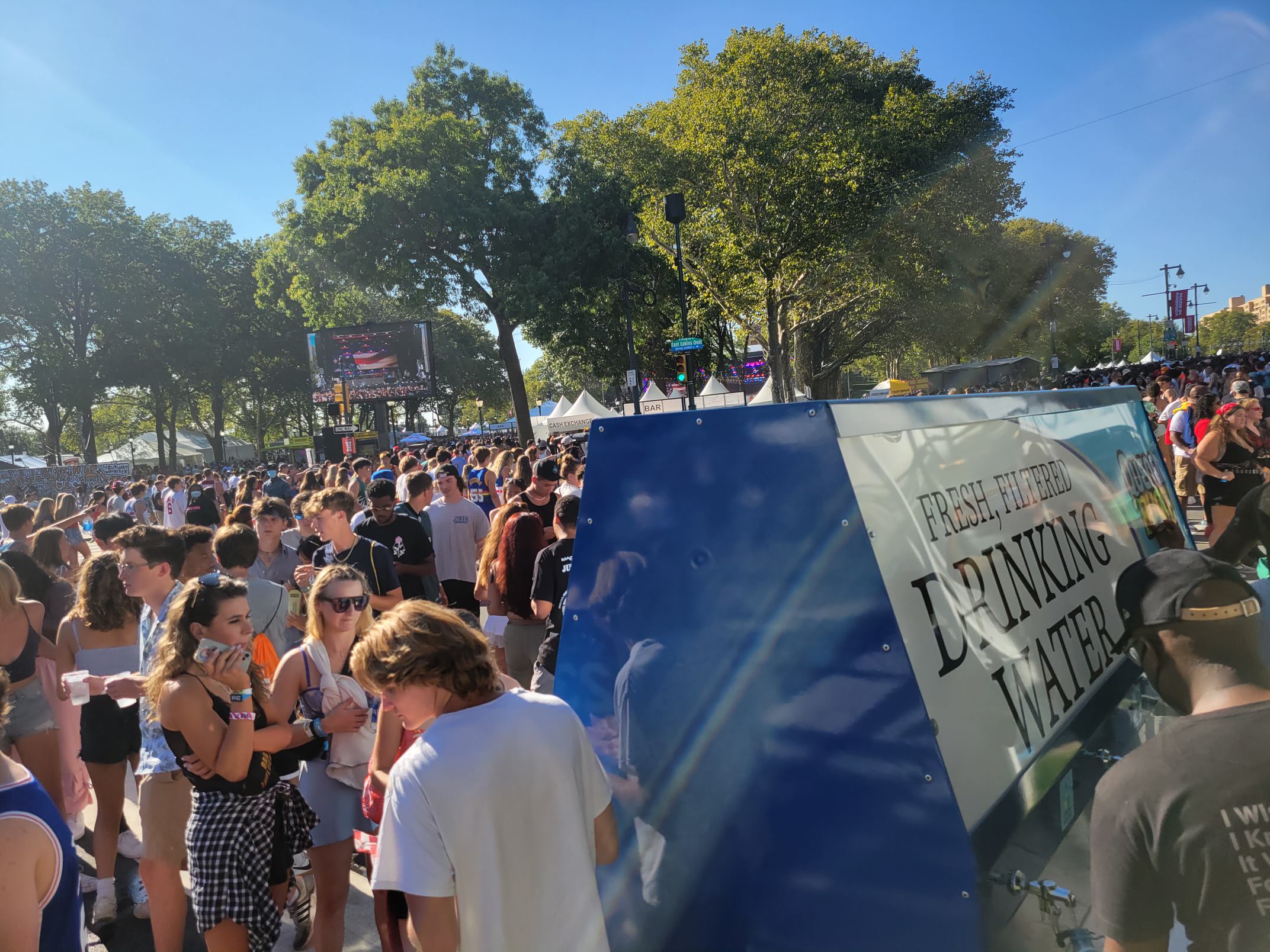
Capacity depends on the type of event, duration, and temperature. Quench Buggy has supported events ranging from 1,000 to over 100,000 people.

This depends on attendance, layout, and usage. A general guideline is one refill point per 1,000 people, though this can vary.

The systems are designed for fast flow, allowing users to refill bottles quickly and efficiently during peak times.

Operational Benefits

By providing consistent access to hydration, it helps reduce the risk of dehydration and related health issues.

It provides convenient access to clean water, reducing wait times and improving comfort.

It is fully managed, meaning your team does not need to handle setup, logistics, or maintenance.

Comparisons & Decision Making

It eliminates the need for transporting, storing, and managing large quantities of bottled water while reducing waste.

Quench Buggy offers a fully managed, high capacity solution with staffing, setup, and scalability.

Industry & Use Case Questions

Event organizers, municipalities, corporations, and industrial operations all benefit from reliable hydration systems.

Yes, it is suitable for both public facing events and internal workplace use.

Yes, the system is designed for both single day and multi day use.

Advanced Planning & Insights

Hydration should be considered early in the planning process to ensure proper placement and capacity.

Underestimating attendance, not accounting for weather, and not providing enough access points.

By providing multiple refill points, it reduces congestion and improves movement throughout the event.

Scalability & Flexibility

Yes, multiple units can be deployed to meet the needs of large scale events.

Yes, it is primarily used outdoors but can be adapted for indoor use depending on the setup.

Yes, it is commonly used in warehouses and distribution centres to support worker hydration.

Final Decision Questions

It removes the complexity of providing hydration, reduces logistical challenges, and ensures reliable access to water.

Customers choose it for the fully managed service, high capacity performance, and ability to deliver a better overall experience.

It provides a scalable and efficient way to handle hydration without ongoing logistical challenges.

The best way to get started is to contact the team, share your event or operational details, and receive a customized recommendation and quote.

FAQs

What water supply does Quench Buggy use?

Quench Buggy only uses a municipally approved source of water, whether it be a fire hydrant, garden hose connection or other.

Does the Quench Buggy have filtration?

All Quench Buggy units have a filtration system in place, including but not limited to UV.

What areas do you serve?

Quench Buggy Rentals have been available anywhere in Canada and the United States and now available anywhere in the world.

Who looks after the unit while it is at the event?

A Quench Buggy trained staff looks after the unit from delivery through to the end of the event

Are units cleaned between events?

All units are cleaned inside and out before each event and cleaned during the event as well.

What does a rental cost?

We use a very simple method for pricing each event, but it does require that you give us a call and tell us details, such as location, number of event patrons, duration of the event, date of the event and any other details that may have an effect on us providing this service.

Can we apply our own graphics to the units?

Yes. To make it easier, we can provide graphic design templates as well. Lots of our clients design and apply their own graphics following delivery of their unit(s).

Do the units hold water?

The Quench Buggy trailer holds 300 gallons of water. The Quench Solo has the option to use 5 gallon reusable jugs to supply water. The Quench Cart does not hold water.

Do your units connect to a city water connection?

All our units have the ability to connect to a city water source.

What type of water source can you connect to?

Any potable, city-approved water source such as hose bib, water fountain or even a hydrant that is approved potable water.

How heavy are the units?

Quench Buggy – 3500 lbs empty u0026 7000 lbs full. Quench Cart – 700 lbs. Quench Solo – 200 lbs.

What is the footprint of the units?

Quench Buggy – 6′ wide x 12′ long x 8′ high . Quench Cart  – 4′ wide x 8′ long x 4′ high . Quench Solo – 2’ wide x 2’ long x 4′ high .

How many faucets are on each unit?

Quench Buggy – 4 bottle fillers and four drinking fountains on each side. Quench Cart – 4 bottle fillers and four drinking fountains. Quench Solo – 1 bottle filler.

Is the water chilled?

Yes, all models include a water chiller that requires a power source.

Is electricity required?

A power source is required to run the chiller. A power source is required to run the pump.

Can the units run off a water tank or water truck?

Yes.

Do you provide staff?

Yes, all rentals are staffed by a member of the Quench Buggy team.

Can graphics be applied to the units?

Yes they can. We can also provide templates to help you with design.

Where should the unit be placed?

On level ground, near a drain and within 100 feet of the potable water source we are connecting to. It’s also recommended to be some distance from the washrooms.

Can these be used for washing dishes or cups?

Quench Buggy units are only intended to be used as drinking water refill stations.

How many people are these intended for?

Short answer, it depends. The type of event, duration & temperature are the main factors. We have served events from 1000 people to 100,000 people and more.